White papersFarm to Fork strategies focus on making value chains ethical, healthy and sustainable. The poultry and egg processing industries are facing unprecedented challenges. Energy and raw material prices are increasing, while consumers are demanding ever lower prices. Meanwhile, the global population continues to grow. The need to improve chicken welfare, maintain a sustainable environment and retain profitability is putting increasing pressure on producers to improve productivity while reducing both energy usage and waste. That’s where Farm to Fork strategies can help. The industry requires solutions that can help to make vital improvements within the areas of: Sustainability – where improvement comes in the form of energy savings, optimized use of water and ventilation, protection of the local environment, and reduction of waste Reliability – where the need to reduce wear and tear on assets, prolong equipment life, and eliminate the risks of unplanned stoppages are all critical to profitable operation Safety – where keeping animals, manufacturing, personnel and consumers safe from harm is non-negotiable. ABB offers application-based solutions for the poultry and egg laying farming sector, food processing sector and logistics across the entire value chain. Our domain expertise, energy efficient motors and variable speed drive (VSD) / variable frequency drive (VFD) technology can help to substantially reduce energy costs, while Programmable Logic Controllers (PLCs) can deliver integrated control systems that help to provide enhanced digital visibility and control over the processes within the poultry farming, food processing and logistics sectors – from Farm to Fork.

White papersIn the oil and gas industry, hydraulic power recovery turbines (HPRTs) capture energy in hydrocrackers that would otherwise be wasted to efficiently drive a charge pump, compressor or generator to power other equipment or operations. The concept is not new. For decades, standard centrifugal pumps have been run in reverse to convert hydraulic energy in the flow of the hydrocracking process. However, less than half of installed HPRT equipment remains in operation. That’s because standard hydraulic turbines have a narrow allowable operating range (AOR). They become unstable when the mix of liquids and gases varies from the pump’s hydraulic design. This can happen any time the feedstock or other process conditions change. Since the HPRT is connected in many cases to the charge pump package, its instability or failure can shut down the hydrocracking process. So, refinery operators will bypass the highly sensitive HPRT, rather than risk the reliability of the hydrocracker, which is at the heart of oil and gas refining. Flowserve enables refinery operators to avoid these issues and supports their corporate initiatives to optimize efficiency, minimize energy costs, and reduce carbon dioxide (CO2) emissions. We convert reverse-running pumps into true turbines with superior energy recovery and stability. Our highly flexible turbine hydraulics can increase efficiency by as much as 7% compared to a conventional reverse-running pump.
White papersThese guidelines will help extend packing life and reduce downtime. No shortcuts should be taken if a plant wants to achieve reliable compression packing performance. However, reliability and a longer life can be obtained by following some basic guidelines. This is important because, the better the performance and reliability of a fluid sealing program, the better the condition of internal pump components. By adhering to the five best practices described in this infographic, plant teams can all but eliminate excessive leakage caused by improper packing installation. They will reduce equipment downtime and have more reliable packing performance.
White paperPressure Testing of DFT® Check Valves [Infographic]
White papersAll DFT Check Valves undergo rigorous tests to ensure they meet industry quality requirements. Check out this handy infographic to learn about their diligent testing.
White papersElectro Static Technology (EST, AEGIS®) guarantees that AC induction motor bearings will not fail from electrical fluting damage when AEGIS Shaft Grounding Rings have been installed with new bearings in accordance with our recommended best practices, as published in the AEGIS Bearing Protection Handbook (current edition).
White papersPumping applications can range from being simple – fluid transferring operations that move product from one tank, container or truck to another – to complex and sensitive, such as chemical manufacturing and refining operations. Because of the importance of the pumping process in the myriad transferring operations in the industry, facility operators need to identify the best pumping technology for the job, one that possesses the versatility to perform reliably and efficiently at any number of points in the production hierarchy. For many years, the centrifugal pump has been the go-to pumping technology for transfer processes, but this white paper will show why positive displacement pumps can be the right pump technology for the right application in transfer operations.
White papersPart 1 of this series discussed in detail how to accurately calculate the reactions induced by pressure transients that travel at acoustic velocity in either liquid or gas piping systems. Part 2 applies these methods to a variety of realistic examples to further illustrate their use and to demonstrate areas in which traditional or simplified methods may impart significant error.
White papersChanges in the operation of piping systems – like valve closures or pump starts – propagate pressure waves that travel at acoustic velocity throughout the fluid. These pressure waves have considerable effect on forces, potentially generating dynamic loads upwards of 10,000 lbf (50 kN) in common configurations. Some estimation methods used in industry for estimating transient forces neglect terms that may be important in some cases. Calculating forces due to these transients without simplification for transient liquid or gas flow is presented here in detail.
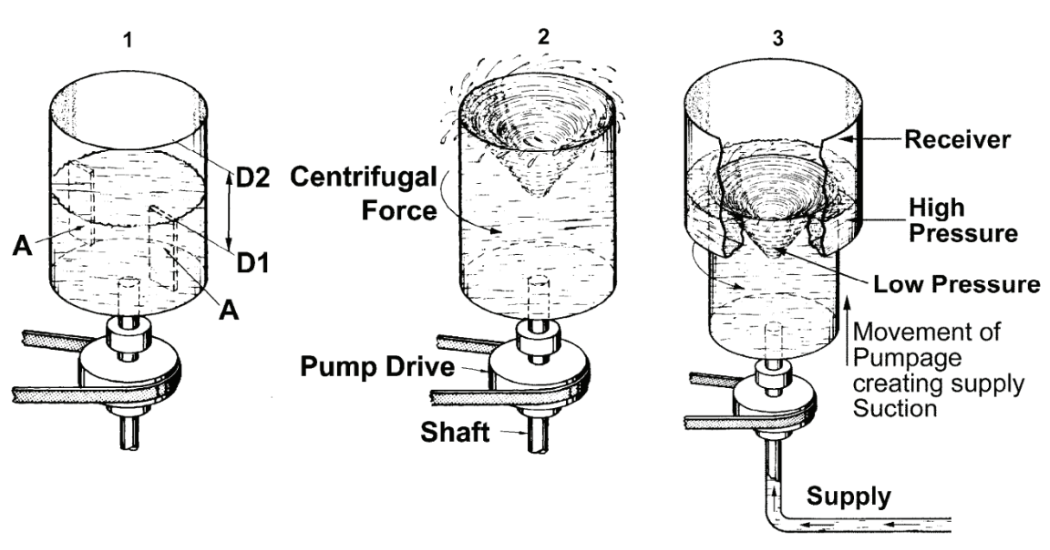
White papersBasic Principle The radial vanes cause pumpage, let’s say water, to rotate in the cylinder. Centrifugal force moves water towards the outside of the cylinder. Since the water can’t move outside the cylinder, it moves upward, and the water will rise from D1 to D2 on the outside edge. Vacuum is created because the water in the middle of the container is pushed down by atmospheric pressure.
White paperTop Reasons to Choose Saniflex™ AODD Pump Diaphragms [Whitepaper]
White papersThe air-operated double-diaphragm (AODD) pump has been a godsend for operators in the industrial space who need a cost-effective, reliable, and safe pump technology for a wide range of liquid-transfer processes. These processes can include such rough-and-tumble utilitarian applications as those found in the mining, water/wastewater, and oil and gas industries, as well as those hygienic food and beverage, pharmaceutical and cosmetic operations that require a bit more finesse. No matter the application, though, the facility operator must take care to choose AODD pump configurations that feature high-performance, long lasting diaphragms. Early AODD pump models – the technology has been available since 1955, or for more than 65 years – were outfitted with simple, fabric reinforced rubber diaphragms. While these rubber diaphragms have performed admirably over these many years, they have a couple of drawbacks: they must be reinforced with a stronger material, and they must be supported by inner and outer plates in operation. Some other shortcomings of synthetic rubber diaphragm models are poor abrasion resistance and, except in the higher end of the synthetic rubber spectrum, limited temperature ranges. These can limit the application range, and shorten the diaphragm’s effective service life, leading to increased maintenance, repair and replacement costs, along with the cost of cleanup and remediation should a pump develop a catastrophic leak because of a failed diaphragm. There have been some notable advances in diaphragm design and the materials used to construct them over the years, and the manufacturers of diaphragms are always looking for ways to improve their products. This white paper will illustrate how the latest advance in diaphragm technology and the introduction of the Saniflex (Hytrel®) model is well on its way to setting a new standard in diaphragm performance and reliability, especially in applications typically handled with Buna.
White papersLong packing life requires proper packing installation, shaft stabilization, and thorough equipment inspections. By David Brewer The stuffing box of a pump houses a gland that compresses the packing used to seal the pumped fluid. It prevents leakage along the shaft that passes through a hole in the pump. The reliability of the stuffing box is critical to the condition and performance of the whole fluid sealing program. The better the performance and reliability of a fluid sealing program, the better the condition of the internal pump components, including the stuffing box. Proper packing installation to prevent excessive leakage, shaft stabilization to prolong shaft/sleeve and packing life, and thorough equipment inspections help improve stuffing box reliability. With these factors, no shortcuts should be taken to ensure ideal overall compression packing performance.
White papersLeading maintenance in a plant, mine, or mill takes a lot of effort. Emergency work comes in a steady stream, some are breakdowns, and other work is just “honey-do-jobs.” The workforce needs to be managed, the budget must be met, and equipment reliability must be maintained and hopefully even improved. This guide will give you insights about conducting a maintenance assessment to help your organization improve reliability and maintenance. Along the way, you’ll learn about the key reliability and maintenance management elements that you should assess and the outcomes you should expect.